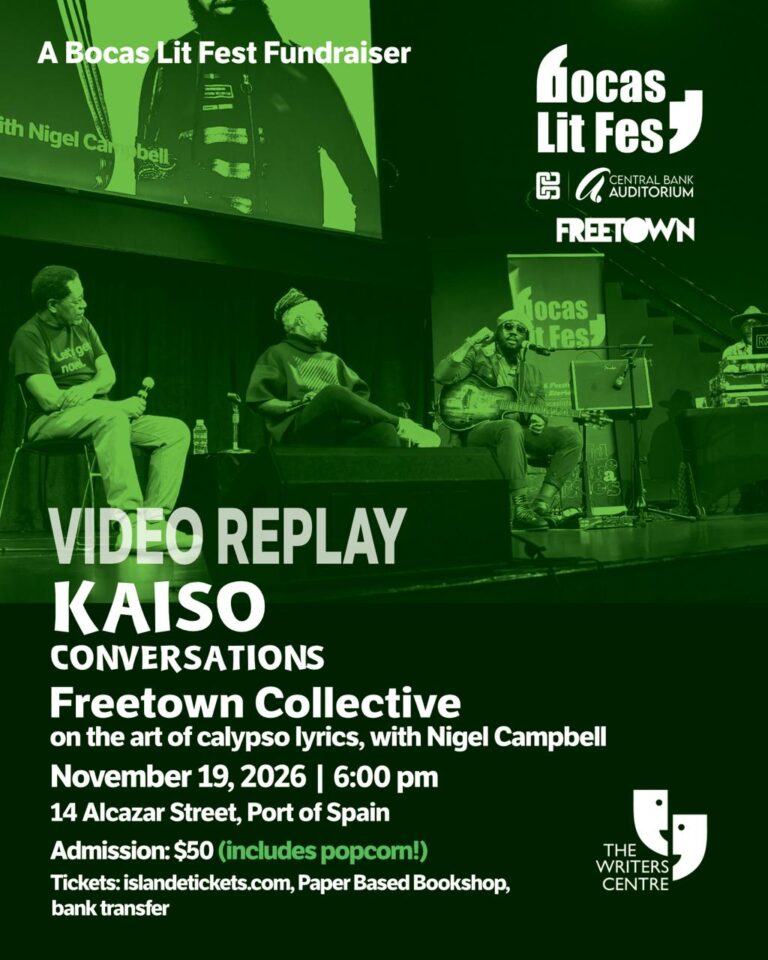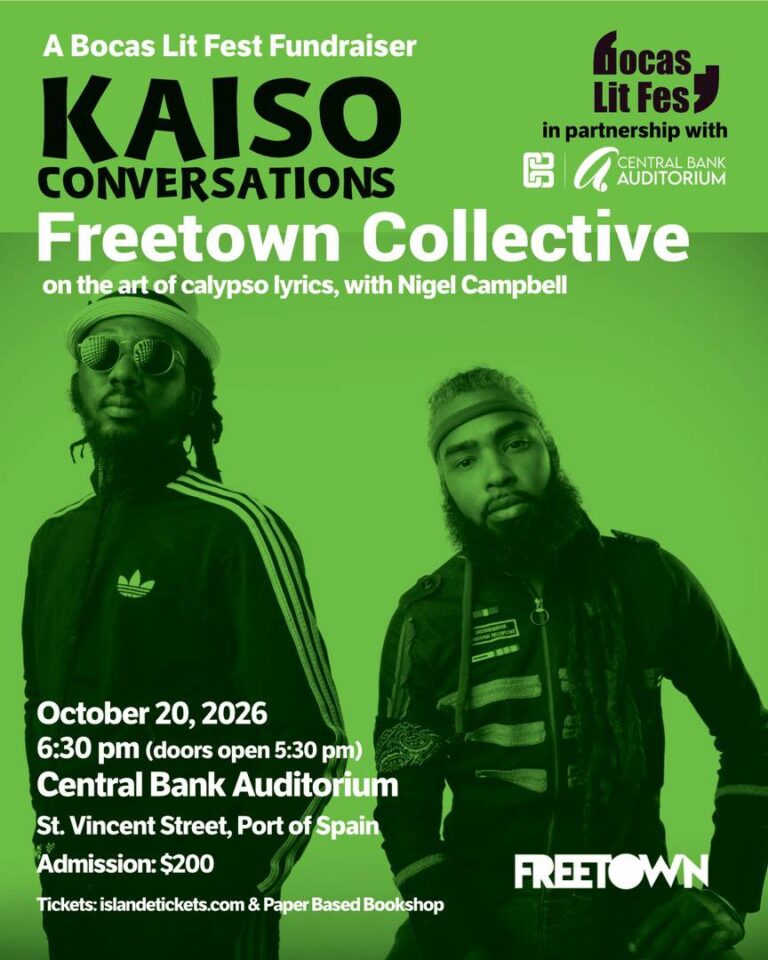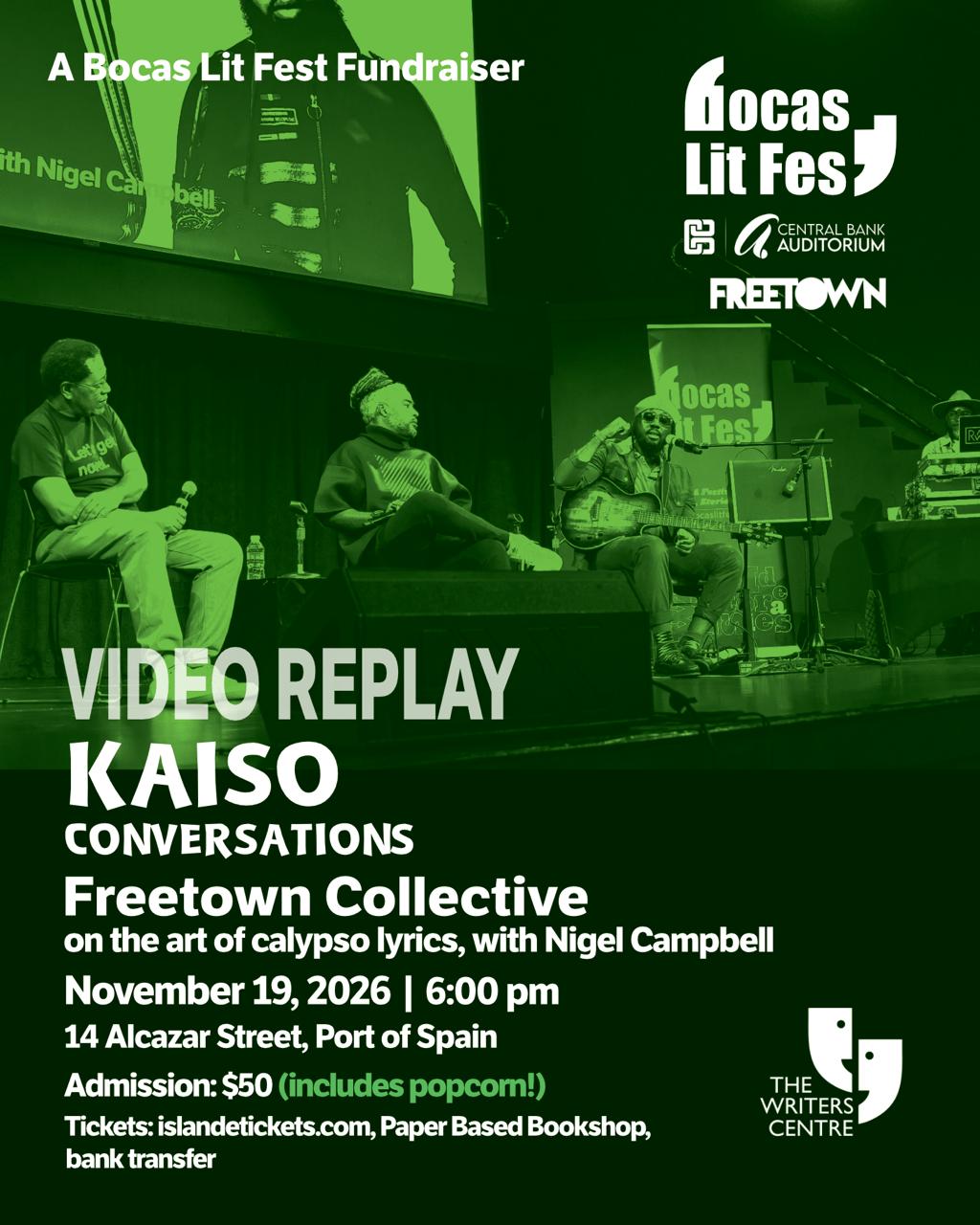
Good evening, everyone, and welcome to this evening’s presentation of Kaiso
Conversations. I am Georgia Popplewell, Operations Director of the Bocas Lit Fest, and
on behalf of the small but mighty Bocas team, let me say how are thrilled to be here this
evening at the Central Bank Auditorium for this event featuring the inimitable Freetown
Collective’s Muhammad Muwakil and Lou Lyons, in conversation with the indomitable
Nigel Campbell.
This is the third event in our Kaiso Conversations series, which began in January this
year with David Rudder, and continued in May with 3 Canal.
When Nigel brought us the idea of a series exploring of the art of songwriting in calypso
and its related musical traditions, we jumped – okay, maybe we jumped in slow motion –
at the idea, which was so totally in sync with our belief that stories, regardless of how
they are told, help shape how we see ourselves, how we understand our society, and how
others see us.
Tonight’s is the last big event in what has been an exceptionally busy year for Bocas. In
addition to two other Kaiso Conversations events, we have managed to produce a huge
amount of programming in 2026, from the annual festival, to the National Poetry Slam,
book launches and readings at The Writers Centre, and, most recently four community
festivals in Couva, Arima, Siparia and Scarborough, Tobago. But this has also been the
most difficult year in our history in terms of funding—I think everyone in this room is
aware of how little support there is these days for cultural organisations. So, reaching this
point in the year, still standing, and gathering for an event like this, feels particularly
meaningful and, frankly, also a bit miraculous.
None of what we have done this year happened without external support. We were
fortunate in 2026 to have received support from companies like Methanex Trinidad,
whose partnership made our community festival series possible.
And tonight we give immense thanks to the Central Bank Auditorium, our
extraordinary partners for this event, who have helped us create space to celebrate the
music of our nation and the art of songwriting.
And naturally, we owe a great deal to the steadfast support of you in this room, the
friends of Bocas – I see a number of frequent flyers in the audience tonight – who attend
our fundraising events and understand why we need to do them. When you buy a ticket –
as I know you know – you are helping us build resilience and sustain the wider work of
the Bocas Lit Fest. Thank you for doing that.
At the Mighty Sparrow’s funeral last Friday, Barbados Prime Minister Mia Mottley called
for the calypso Slave, penned by Winsford Devine but made immortal by Sparrow’s
rendition, to be included in the CXC curriculum, arguing that every Caribbean child
should understand its message about the unfinished business of our history.
It was a reminder that calypso and its various descendants are, at their best, never simply
entertainment. They are a way of documenting our lives, interrogating our societies,
challenging authority and giving voice to experiences that might otherwise go
unrecorded. Calypso has long provided a means for Caribbean people to tell their stories,
inspire action, and find both joy and relief in the pressures of everyday life. That idea is
at the heart of these conversations.
At the first event with David Rudder, I spoke in my opening remarks about how, from the
moment we heard The Hammer and Bahia Girl in 1986, we recognised that we were in
the presence of a writer—a chronicler of our society and our world. Rudder helped
expand the possibilities of calypso, bringing a new poetic ambition to the art form.
With 3 Canal, we explored another strand of that evolution: rapso and its fusion of the
rhythms of calypso, oral traditions and theatre, and how it explores questions of identity,
politics and the complexities of Caribbean life.
Tonight, we welcome a newer generation of performers and songwriters. Freetown
Collective inhabit a different musical moment from Sparrow, Rudder and 3 Canal, but
they are part of the same ongoing story: artists drawing on the rhythms, language, history
and experiences of this region to create something that speaks to their own time.
Freetown’s music crosses boundaries between genres, and their songwriting engages with
questions of identity, belonging, justice, love and the kind of world we want to build.
They remind us that the evolution of calypso and its wider musical family is about
allowing each generation to reshape the form, challenge it, make it their own.
And perhaps that is the most important throughline connecting the artists we’ve featured
in this series so far. These are musicians who take the craft of songwriting seriously and
understand that songs matter because of the ideas and experiences they carry. The
melodies may change, the arrangements may shift, the audiences may be slightly
different, but the impulse to make sense of ourselves through music remains.
And now it is almost time to move on to the main event. But before we do that, please
welcome Ms. Abigail Edwards, Manager External Relations, Central Bank of Trinidad
and Tobago to say a few words on behalf of the Central Bank.